When Parenting Advice Fails in the Moment: Practical Scripts for Screen Time, Bedtime, and Refusal
Quick Summary: Parenting advice often collapses under pressure because an overwhelmed child cannot process complex logic, while an exhausted caregiver defaults to over-explaining [1] [2]. Practical scripts are not magic guarantees of instant compliance; they are short, pre-planned anchors that help adults pause, acknowledge feelings, and hold predictable boundaries during screen time, bedtime, and defiance [3] [2].
When a daily routine derails—whether it is a meltdown over turning off a tablet, an evening standoff at bedtime, or flat-out refusal to get dressed—even the most sensible parenting books can vanish from memory. In high-friction moments, children temporarily lose their ability to engage with reasoned explanations, while adults facing cognitive overload often talk faster, louder, or longer [1] [2].
Communication scripts solve this mismatch by reducing the mental load of improvising under stress [2]. Rather than serving as rigid formulas to control behavior, adaptable scripts provide a steady, kind, and firm starting point to hold necessary limits while keeping the parent-child connection intact [4] [3] [2].

Why the Right Advice Disappears in the Moment
Quick Summary: In high-stress moments, parenting principles often vanish because an emotionally flooded child cannot process complex logic, while an overloaded parent naturally defaults to talking faster, longer, and sharper. Off-the-shelf advice also tends to overlook developmental fit, making prepared, adaptable scripts a practical anchor rather than a magic fix.

Even well-researched parenting strategies can evaporate during a 7:40 a.m. rush. In tense situations, a child who is frustrated or overwhelmed becomes emotionally flooded, temporarily losing the capacity to engage with reasoned arguments or multistep instructions [1]. Simultaneously, a tired or hurried caregiver faces cognitive overload. When adults feel pressed for time or pushed to their limits, their default stress response is often to over-explain, increase vocal intensity, or deliver lengthy lectures—demands that a dysregulated nervous system simply cannot absorb [1] [2]. This creates a predictable mismatch: the child needs less verbal stimulation, but the adult provides more [1] [2].
Compounding this friction is the reality that general parenting tips often lack developmental fit. Broad, one-size-fits-all advice may not account for a child's age, abilities, or developmental needs. When expectations do not match what a child is neurologically capable of handling in that exact moment, attempts to enforce a generic rule can inadvertently escalate the standoff [5].
Recognizing this dynamic helps reframe the role of communication scripts. Prepared phrases are not magic words designed to guarantee instant compliance, nor does struggling in the moment mean a parent has failed [1] [3] [2]. Instead, scripts are simple, adaptable patterns intended to reduce the cognitive burden of improvising under pressure, giving adults a steady, grounded place to start [3] [2].
A Repeatable Script Pattern You Can Use Under Pressure
Quick Summary: Pause, acknowledge what is happening, state the limit, and offer a small choice or clear next step. Keep the words brief and the boundary predictable.
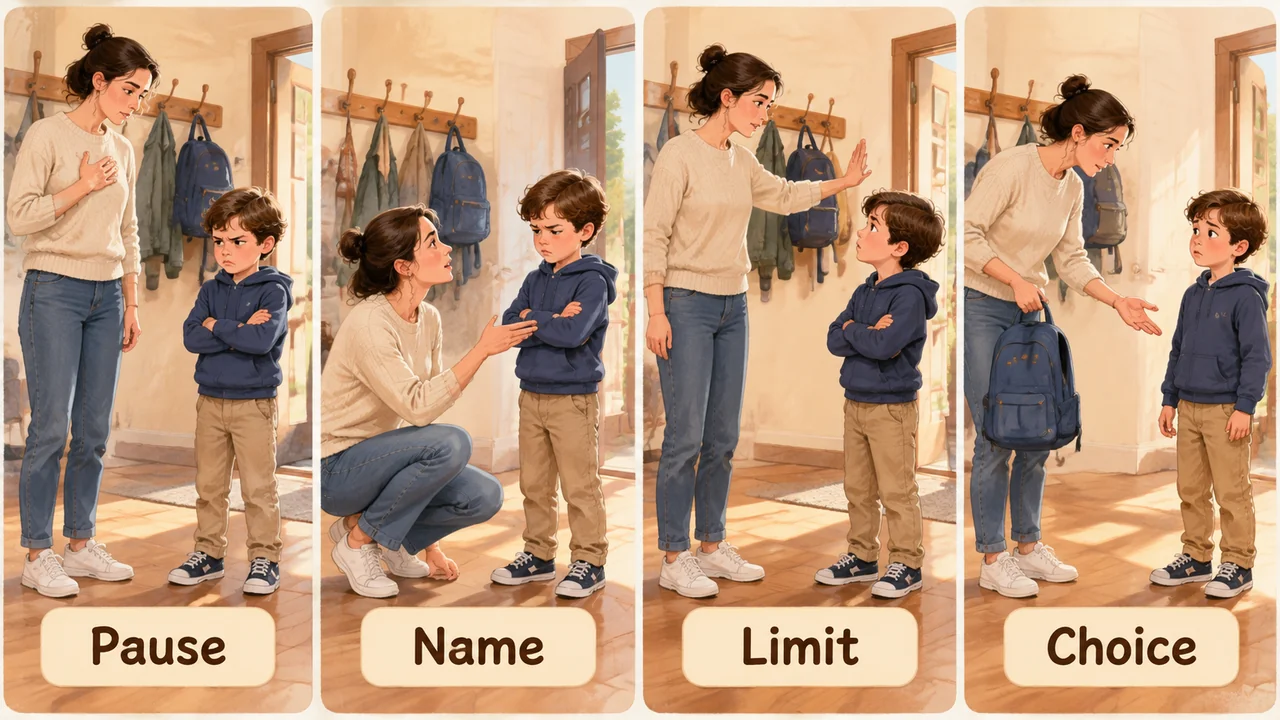
This four-move pattern is an editorial synthesis of practical parenting guidance. The sources do not test this exact sequence as a validated program; use it as a flexible prompt.
Pause and shorten your response. Take a breath before speaking. A quiet reminder to yourself—“I can be kind and keep this limit”—can be your starting point. Aim for a brief response rather than a long explanation. [4][2]
Name the feeling or situation. Try “You wanted to keep playing” or “Stopping feels hard.” If you are unsure how your child feels, describe what you can observe: “You’re still building.” Keep the acknowledgment free of labels such as “naughty” or “dramatic.” [2]
State the limit plainly. Say what needs to happen: “It’s time to leave.” Acknowledge disappointment while keeping the required action clear. The sources pair empathy with direct limits. [4][6]
Offer a small choice or one next step. Try “Do you want to walk beside me or hold my hand?” Offer only options you can accept. A next step can also be an offer of help: “I’ll help you get started.” [2]
Fill-in frame: “You [feeling, wish, or situation]. It’s time to [limit or required action]. You can [acceptable option A] or [acceptable option B].”
Adapt the wording so it sounds like you. If your child keeps negotiating, repeat the brief boundary without adding another explanation. The words can change while the limit remains predictable; immediate agreement is not guaranteed. [3] [2]
Screen Time: What to Say Before, During, and After the Transition
Quick Summary: Use fewer words, give advance notice, acknowledge that stopping is hard, hold the same end point, and offer one acceptable next step [2][6]. The wording can change with your child’s age and routine; the boundary should not.
A practical script collection treats many screen-time conflicts as transition problems—children having to shift from “engaged” to “stopped”—rather than simple defiance [7]. Treat that as a useful lens, not a measured prevalence. The scripts below are illustrative phrasing to adapt, not evidence that any line will end every protest.
| Moment | Script pattern to adapt | Boundary it keeps | Caveat or adaptation |
|---|---|---|---|
| Two-minute warning | “Two more minutes, then we’re saving the game and coming to dinner. Want to set the timer or should I?” [7] | The end time stays fixed; the child gets a small role in the transition. | The supplied scripts use different warning lengths—two minutes here, five minutes elsewhere [6]. Choose one your child can track, and use a visual timer if needed. |
| The ‘five more minutes’ loop | “I can see you’re really into this. What’s the next stopping point in the show?” [7] | The rule is not extended indefinitely; the child moves toward a natural finish. | This works only when there is a real endpoint. If there is not, repeat the limit and the next step instead of opening a new negotiation [2]. |
| End of approved time | “Screens are done at 7. Would you rather read with me or build with blocks until bedtime?” [7] | The endpoint stays the same; two acceptable next activities replace a screen-or-nothing choice. | Offer choices you can actually honour. A choice is an invitation to cooperate, not a debate that must continue [2]. |
| Saving a game or episode | “Let’s finish this level or episode, then it’s time to turn off the screen. Let’s save your progress so you can continue tomorrow.” [6] | The screen still goes off after the agreed stopping point. | The wording assumes a short, visible ending; choose a stopping point your child can see rather than an open-ended level. |
| Morning request for screens | “First we’re getting dressed and eating breakfast. After that, we’ll see if there’s time for a show before school.” [7] | Routine comes first; screens remain conditional rather than promised. | If “we’ll see” creates repeated bargaining, pair it with a clear family rule or a visible clock. |
Before the transition, give advance notice and plan the next activity [6]. During it, shorten your response: name what is happening, hold the limit, and offer one safe choice [2]. After it, keep the next step concrete. If your child protests, repeat the boundary rather than adding a new explanation [2].
Bedtime: A Calm Sequence for 'I'm Not Going to Bed'
Quick Summary: A staged bedtime routine may give families more than one point to support the transition. Consider advance notice, a device cutoff buffer, small choices within the routine, and a brief, repeated boundary if resistance continues.
The Bedtime Transition Timeline
When a child announces, "I'm not going to bed and you can't make me," launching into an argument about authority usually deepens the conflict. Managing the evening as a staged transition reduces defensiveness before the standoff begins.
- Phase 1: Advance notice (about 10 minutes out)
Signal the shift before demands start. Rather than springing bedtime on an absorbed child, provide an orienting cue: "In 10 minutes, it will be time to start our bedtime routine. What would you like to do until then?" [6]. Establishing predictable rhythms helps children anticipate expectations instead of feeling blindsided [4]. - Phase 2: The device cutoff buffer (e.g., 30 minutes before bed)
If devices are involved, schedule an explicit gap between screen power-down and lights-out. For example, setting screens to turn off at 7:30 for an 8:00 bedtime provides a clear 30-minute buffer for hygiene, books, and winding down [7]. This is an illustrative transition buffer, not a universal bedtime rule [7]. - Phase 3: Autonomy inside the steps
Prevent resistance by offering narrow choices within non-negotiable boundaries: "It is sleep time. You can choose the blue pajamas or the striped pajamas" [2]. The child exercises agency over how the routine unfolds without opening a debate about whether it happens. - Phase 4: Diffusing the direct standoff
If met with flat refusal ("You can't make me!"), respond first with brief connection or playfulness to disarm opposition. Acknowledging the underlying feeling—"Going to bed feels boring when you're still having fun, doesn't it?"—or using light humor lowers defensive walls far faster than threats [4]. - Phase 5: The steady, repeated limit
When stalling or bargaining persists, do not introduce new arguments. Restate the core limit in a calm, neutral voice ("It is sleep time") without debating terms [2]. Repetition signals steady leadership and keeps bedtime predictable.
Refusal and Backtalk: Scripts That Hold the Boundary
Quick Summary: Acknowledge the objection, keep the reasonable limit clear, and offer a manageable next step. If every choice gets a “no,” offer help rather than extending the negotiation. [2]
Match your response to what is happening. These examples adapt practitioner guidance; they are not tested, age-specific formulas or promises of cooperation.
| Situation | Script to adapt | Limit it holds | Caution or adaptation |
|---|---|---|---|
| Leaving a preferred place | “You wish we could stay. It’s time to leave. Walk beside me or hold my hand?” | Leaving is decided; how to approach the exit offers some choice. | If your child stays stuck, offer concrete help: “I’ll get your bag; let’s head to the gate together.” Match help to their abilities. [4] [2] |
| Rejecting every choice | “You don’t want either. We still need to get dressed. Shirt or pants first? I can help you start.” | The task remains; choosing is optional. | Repeat the two acceptable options calmly, then offer help. Avoid adding an endless menu or treating the rejected choices as a new offense. [4] [2] |
| Backtalk or name-calling | “You’re angry about my answer. You can tell me you disagree. We don’t call each other names.” | Disagreement is allowed; name-calling crosses the limit. | If insults continue, pause the argument and return when calmer. Address the words without labeling the child “rude” or “bad.” [4] [6] |
| Refusal from an older child | “The dishes still need doing. Let’s talk privately about what’s getting in the way.” | The responsibility stays clear while you hear their objection. | Use direct language and privacy. Invite them to help choose respectful wording for future disagreements. [2] |
For immediate safety, state the limit directly: “I won’t let you hit.” Offer choices only within what is safe; protecting someone does not depend on the child choosing an option. [2] [6]
When the Script Still Fails: Troubleshoot, Repair, and Prepare
Quick Summary: When a script misses, treat it as a review point, not proof that the boundary failed. Simplify your words, add missing support, hold the limit, repair, then rehearse one phrase for next time. Scripts are flexible examples, not magic phrases [3][2].
Troubleshooting checklist
Use this list when the same script has failed more than once.
- Narrow the target. Name one recurring problem instead of “nothing works” [1].
- Check this moment. Ask whether your child can meet the demand now, not on their best day; if not, try the first step together [1].
- Cut the words. When feelings are high, one clear sentence works better than a long explanation: “I am ready to help when your voice is calmer” [1].
- Track patterns. Note the timing, transitions, and specific demands that reliably trigger trouble [1].
- Add support. A snack, visual reminder, shorter instruction, transition warning, or calmer space may help more than firmer wording [1].
- Hold the limit warmly. “I know you’re disappointed. We’re still leaving” keeps the boundary without surrender or escalation [1].
- Give it time. Allow several days to a couple of weeks unless the plan is worsening things; seek outside help if behavior is unsafe or getting worse [1].
Repair and prepare
After a snap, reconnect before teaching. A simple repair: “I was frustrated and I shouted. I am sorry. I am going to try again” [2]. Keep the internal reminder brief too: “I can always reconnect. I can repair. This was one hard moment, not the whole story” [4].
For next time, practise one short phrase when everyone is calm, and adapt it until it sounds like you [3] [2]. Choose one phrase to start with, keep it short, and review the routine around the hard moment as well as the words [8] [2]. For a structured way to prepare, Say It Steady is a parenting communication app for adults with children ages 4–14: choose a situation, add details about your child and what is happening, and receive a communication plan to adapt. It is a starting point, not a guarantee of cooperation.
Frequently Asked Questions
What can I say when my child keeps asking for 'five more minutes' at bedtime or screen time?
Try: “You really want more time. Screen time is finished. Let’s save what we can and turn it off.” At bedtime: “You wish we could keep playing. It’s time for pajamas. Blue ones or striped ones?” Acknowledge the wish, repeat the limit briefly, and move to the next step. [2] [6]
If you allow time to finish an episode or activity, agree on that stopping point beforehand so each request does not reopen the negotiation. [7]
Why does the script I planned disappear once I'm frustrated or running late?
Pressure makes improvising harder. When you are tired or rushed, you may slip into familiar reactions: repeating instructions, overexplaining, or raising your voice. A long, carefully planned speech can become difficult to use in that moment. [1] [2]
Prepare one short line instead: “We need to leave. I can help you start.” Practise saying it aloud when calm, and keep a written reminder near the difficult transition. Use wording that sounds natural to you. [3] [2]
What should I do when my child refuses every choice I offer?
Stop expanding the menu. Say: “You don’t want either option. We still need to get ready. I’ll help with the first step.” Choices can offer some control, but your child does not have to select one before you can offer practical support. [2]
For example, bring the shoes over and invite your child to sit beside you. If they remain stuck, check whether the task needs simplifying or something feels uncomfortable or overwhelming. Keep the next action small. [1]
Do these scripts work the same way for a 4-year-old and a 12-year-old?
Keep the basic approach—acknowledge, state the limit, offer a next step—but adapt the language and support. A younger child might hear: “Tablet finished. Let’s put it on the shelf.” An older child might hear privately: “Our agreed screen time is over. What would help you wrap up on time tomorrow?”
Older children may prefer direct language and a say in planning future routines. These are practical adaptations, not evidence that identical scripts work equally across ages. Match your words to your child’s understanding and abilities. [2]
How long should I keep using a script before deciding it isn't working?
For an everyday recurring problem, try a clear, consistent plan for several days to a couple of weeks, provided things are not worsening. That is a practical review window, not a proven deadline. [1]
Look beyond immediate agreement: Are arguments shorter? Are you repeating yourself less? Is the transition easier with help? If little changes, review timing, hunger, fatigue, and task difficulty alongside the wording. Seek support sooner if behavior becomes unsafe or causes persistent distress. [1]
What should I say after I lose my temper and the script fails?
Say: “I shouted. That wasn’t okay, and I’m sorry. I’m going to slow down and try again.” Take responsibility without blaming your child for your reaction. Reconnect before explaining or teaching. [2]
If the original limit remains reasonable, restate it gently: “Screen time is still finished. I can help you save and switch it off.” Later, discuss one change for next time, such as an earlier warning or a pause when you notice your voice rising. [1] [6]
Conclusion
When a script does not immediately end a conflict, remember that its primary function is not to control your child's feelings or force immediate compliance. Its real job is to steady you [2]. By trading lengthy arguments for a predictable, concise boundary, you offer your child a calm container and model the self-regulation they are still developing [4] [1] [2].
Progress with everyday boundaries takes time and repetition [1]. Expect occasional pushback during difficult transitions, allow consistent routines several days to take root, and view moments where you lose your patience not as proof of failure, but as opportunities to model repair [4] [1] [2]. If you regularly struggle to find the right words in tense moments, rehearse a couple of core phrases during calm hours—or use tools like Say It Steady to organize and adapt your plans in advance. With fewer words, clearer boundaries, and steady warmth, you can navigate even the hardest standoffs one step at a time.
References
- [1] What to Do When Nothing Seems to Work
- [2] Parenting Scripts for Difficult Moments | Simplee Parenting
- [3] Parenting Scripts for Everyday Challenges
- [4] What to Say When Kids Tantrum, Talk Back or Won’t Cooperate
- [5] Why, what, and how to use AI to assist parenting: Introducing the HEAT model
- [6] Parent Scripts | Psychologist for Parenting
- [7] 10 Calm Scripts for the Trickiest Screen-Time Moments | Calm Family Printables
- [8] Momentures | Practical Parenting Guides, Scripts & Printables